
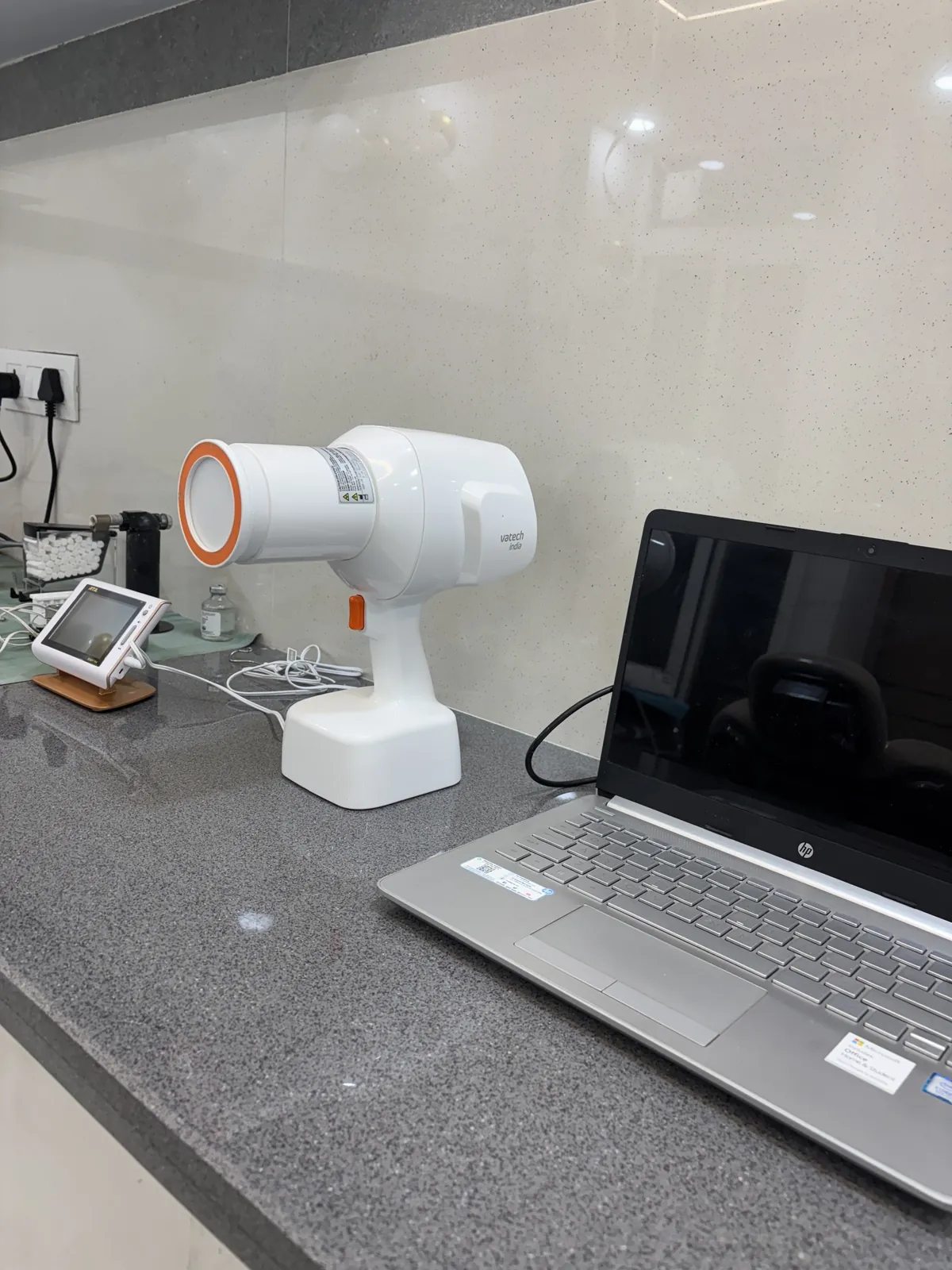
Patients ask about X-ray safety more than almost anything else, and it is a reasonable thing to ask. The answer is easier to judge with actual numbers rather than reassurance.
The doses
Radiation is measured in microsieverts (µSv). For rough comparison:
- A single digital dental X-ray: around 1–5 µSv.
- A full-mouth OPG panoramic: roughly 10–25 µSv.
- Natural background radiation, per day, just from living: about 8–10 µSv.
- A flight from Delhi to London: roughly 40–60 µSv.
- A chest X-ray: about 100 µSv.
- A CT scan of the abdomen: around 8,000 µSv.
So a single digital dental X-ray is comparable to a few hours to half a day of ordinary background exposure. A dental CBCT scan, used for implant planning, is higher — in the range of 50–200 µSv — but still a small fraction of a medical CT.
Why digital matters
Digital sensors need far less radiation than the film they replaced — commonly cited as a 50 to 80 per cent reduction. They also produce an image immediately, so there are no retakes for processing errors, and the image can be enlarged and adjusted rather than re-exposed.
The risk of not taking one
This side of the comparison is usually left out. Decay between teeth is invisible to the naked eye until it is large. Bone loss from gum disease, infection at a root tip, cysts, impacted teeth and many early cancers are found on radiographs and nowhere else. Diagnosing by eye alone means finding these things later, when treatment is bigger.
The principle dentists work to is ALARA — as low as reasonably achievable. X-rays should be taken because a specific clinical question needs answering, not routinely at every visit. If you are ever unsure, it is entirely fair to ask what the film is looking for.
Pregnancy
Dental X-rays are considered safe in pregnancy when needed, because the beam is directed at the jaw and the dose is tiny; measurable exposure to the uterus is effectively nil, and a lead apron with a thyroid collar reduces it further. Even so, elective radiographs are usually deferred to after delivery, while urgent ones — for infection or pain — go ahead, because an untreated dental infection is a greater risk to a pregnancy than the film. Always tell your dentist if you are or might be pregnant.
Children
Children are more radiosensitive than adults, so films are taken less often and settings are reduced for their size. They are still important: decay progresses faster in baby teeth, and radiographs show developing permanent teeth, missing teeth and impactions while there is still time to plan.
Frequently asked questions
How often do I need dental X-rays?
Typically every one to two years for an adult at average risk, and more often if you have had recent decay or active gum disease. There is no fixed schedule — it depends on your risk.
Can I refuse dental X-rays?
Yes, it is your decision. Understand that some conditions cannot be diagnosed without them, so treatment may have to proceed with incomplete information, or be deferred.
Are dental X-rays safe while breastfeeding?
Yes. X-rays do not affect breast milk in any way, and there is no need to pause feeding or discard milk afterwards.
Is a lead apron still necessary?
Several international bodies now consider it unnecessary with modern digital equipment and tight beam collimation. Many clinics, including ours, still offer one because patients find it reassuring and it does no harm.
Talk to a dentist in Dehradun
X-rays are taken to answer a specific question, not routinely. If you would like this looked at, it is what we do every day at Vital Dental Care & Implant Center, Haripuram Colony, 2 GMS Road, Engineers Enclave, Kanwali, Dehradun, Uttarakhand 248001 — close to Vasant Vihar, Kamla Palace, Chaman Vihar, Majra and Niranjanpur (how to reach us).
- Consulting hoursSunday to Friday, 10:00–14:00 and 16:00–20:00. Closed Saturday.
- Treating dentistDr. Pragati Singh, B.D.S., M.D.S. — Endodontist
- Appointments92868 98353 or WhatsApp
Related: Stages of tooth decay, dental care in pregnancy, check-up frequency.
At the clinic: Root canal treatment in Dehradun.