
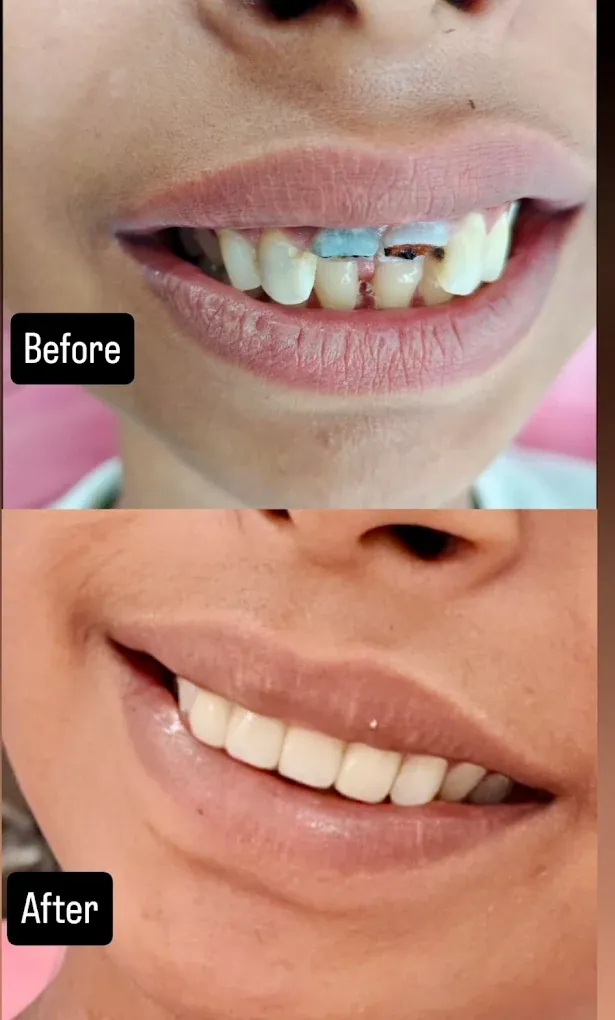
A veneer covers the front surface of a tooth, like a facing. A crown covers the whole tooth, like a cap. Everything else follows from that.
How much tooth each costs you
A veneer typically requires removing around 0.3 to 0.7 mm from the front surface only — sometimes none at all with ultra-thin designs. A crown requires reducing every surface, usually 1 to 2 mm all round. That is a substantial amount of healthy tooth, and it never grows back. It also brings the preparation closer to the nerve, which is why a small proportion of crowned teeth eventually need root canal treatment.
This is the whole decision in one sentence: choose the option that removes the least tooth while solving the actual problem.
When a veneer is right
- The tooth is fundamentally sound, with only the front surface at fault
- Discolouration that whitening cannot fix, such as tetracycline staining or fluorosis
- Small chips, worn edges or minor shape irregularities
- A gap between front teeth you want closed without braces
- Slightly crooked front teeth, where the bite is otherwise fine
When a crown is right
- The tooth is heavily filled, with little sound structure left
- After root canal treatment on a back tooth
- The tooth is cracked, and needs holding together
- Large decay, or a failed large filling
- Heavy grinding that would shear a veneer off
Composite or ceramic veneers?
Composite is built up and shaped by the dentist in a single visit, costs least, needs little or no tooth removal, and can be repaired easily. It stains at the edges over time and usually needs replacing after five to eight years.
Ceramic is laboratory-made across two visits, resists staining, looks more lifelike and lasts ten to fifteen years or more — but costs more and requires that small irreversible preparation.
The honest warnings
Veneers are not reversible once the tooth is prepared; that tooth will need a veneer or crown for the rest of your life. They can chip or debond, and heavy grinders need a night guard or should not have them at all. They do not change colour, so whitening should be done before the shade is chosen, never after. And a “full set” of eight to ten veneers on teeth that are basically healthy is a large, permanent intervention — worth a second opinion before agreeing.
If crowding is the real problem, orthodontics moves your own teeth into line and removes nothing. It takes longer. It is frequently the better answer.
Frequently asked questions
Do veneers ruin your teeth?
They are not reversible. Preparing a tooth for a ceramic veneer removes a thin layer of enamel permanently, so that tooth will always need a veneer or crown. Composite veneers often need little or no preparation.
Which lasts longer, a veneer or a crown?
Crowns generally last longer because they cover and protect the whole tooth. Ceramic veneers commonly last 10 to 15 years, composite veneers 5 to 8.
Can I whiten my teeth after getting veneers?
No. Veneers do not change colour, so whitening must be done first and the veneer shade matched to the whitened teeth. Whitening afterwards only lightens the teeth around them.
Are veneers a good option for crooked teeth?
For slightly crooked front teeth with a healthy bite, sometimes. For genuine crowding, braces or aligners move your own teeth and remove no tooth structure, which is usually the better long-term choice.
Talk to a dentist in Dehradun
Choose whichever option solves the problem while removing the least tooth. If you would like this looked at, it is what we do every day at Vital Dental Care & Implant Center, Haripuram Colony, 2 GMS Road, Engineers Enclave, Kanwali, Dehradun, Uttarakhand 248001 — close to Vasant Vihar, Kamla Palace, Chaman Vihar, Majra and Niranjanpur (how to reach us).
- Consulting hoursSunday to Friday, 10:00–14:00 and 16:00–20:00. Closed Saturday.
- Treating dentistDr. Pragati Singh, B.D.S., M.D.S. — Endodontist
- Appointments92868 98353 or WhatsApp
Related: Cosmetic dentistry, crown materials, smile design.