
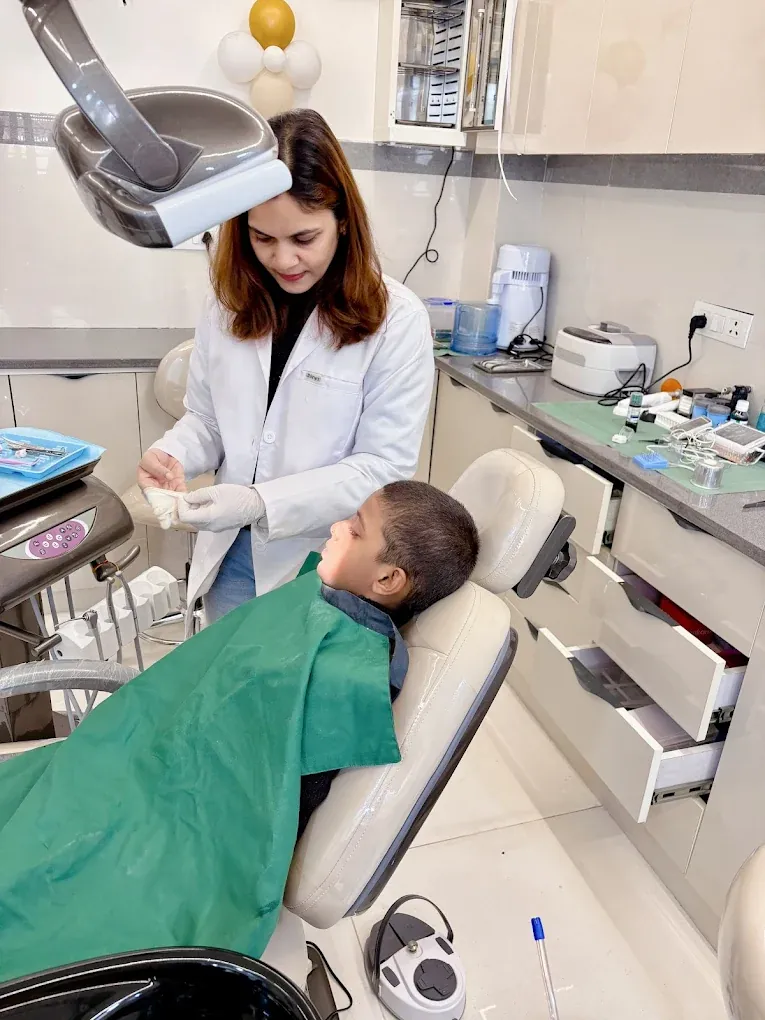
The most common thing parents say when we find decay in a four-year-old is that the tooth will come out anyway. It is a reasonable thought and it is wrong for a specific anatomical reason: the permanent successor is developing in the bone directly above the root of that milk tooth. An abscess at that root sits right against the forming enamel of the adult tooth, and can leave it permanently discoloured or malformed — a defect called Turner's tooth.
Why milk teeth decay faster
Milk-tooth enamel is roughly half the thickness of adult enamel, and the pulp chamber is proportionally much larger. Decay therefore reaches the nerve far quicker — what would be a small filling in an adult can reach the pulp of a milk tooth in months.
Early childhood caries
The classic pattern is decay on the upper front teeth, appearing first as dull white bands along the gumline and then turning brown. It is caused by prolonged contact with anything sweetened, and the commonest causes are a bottle of milk or juice taken to bed, and unrestricted breastfeeding through the night once teeth are present and no cleaning is being done.
The mechanism is saliva. During sleep, saliva flow almost stops, so milk pools around the upper front teeth for hours with nothing to wash or neutralise it. The lower front teeth are protected by the tongue, which is why the pattern is so recognisable.
What helps: no bottle in bed — water only if one is needed — move to a cup at around twelve months, wipe or brush the teeth after the last night feed, and avoid sweetened milk, juice in bottles and constant sipping of sweet drinks.
What treatment looks like
- Fluoride varnish for early white-spot lesions, which can still remineralise.
- Fissure sealants on the deep grooves of back teeth.
- A tooth-coloured filling for an established cavity.
- Pulpectomy — the milk-tooth version of a root canal — where decay has reached the nerve but the tooth is worth keeping.
- A stainless steel crown for a badly broken-down back tooth. It looks metallic, but it is durable, it is cheaper than repeated failed fillings, and it will fall out with the tooth.
- Extraction with a space maintainer where the tooth cannot be saved and the gap needs holding open.
Doing it without frightening the child
The first appointment for a child with decay should not be the one where treatment happens. We introduce the chair, the mirror and the sounds first, use tell-show-do so nothing is a surprise, and start with the easiest tooth so the child collects a success early. Local anaesthetic is placed after a numbing gel, and nobody is held down.
One request for parents: never say “it won't hurt” or use the dentist as a threat for bad behaviour. Both make our job considerably harder.
Frequently asked questions
Can decay in a milk tooth affect the permanent tooth?
Yes. The permanent tooth forms directly above the milk tooth's root. An abscess there can disturb the enamel as it develops, leaving the adult tooth discoloured or malformed.
Is night breastfeeding bad for a baby's teeth?
Breastfeeding has clear benefits and should not be stopped for dental reasons. The risk comes from frequent night feeding once teeth are present with no cleaning. Wipe or brush the teeth after the last feed.
Why would a child need a metal crown on a baby tooth?
Because a large cavity in a small tooth leaves little structure for a filling to grip. A stainless steel crown covers the whole tooth, lasts until it falls out naturally, and avoids repeated re-treatment.
Does my child need fillings if the tooth will fall out in two years?
Usually yes. Two years is long enough for decay to reach the nerve, cause pain and abscess, and affect the developing permanent tooth. If the tooth is very close to falling, we may monitor instead.
Talk to a dentist in Dehradun
Untreated decay in a milk tooth can mark the adult tooth forming above it. If you would like this looked at, it is what we do every day at Vital Dental Care & Implant Center, Haripuram Colony, 2 GMS Road, Engineers Enclave, Kanwali, Dehradun, Uttarakhand 248001 — close to Vasant Vihar, Kamla Palace, Chaman Vihar, Majra and Niranjanpur (how to reach us).
- Consulting hoursSunday to Friday, 10:00–14:00 and 16:00–20:00. Closed Saturday.
- Treating dentistDr. Pragati Singh, B.D.S., M.D.S. — Endodontist
- Appointments92868 98353 or WhatsApp
Related: Milk teeth timeline, is fluoride safe?, children's dentistry.