
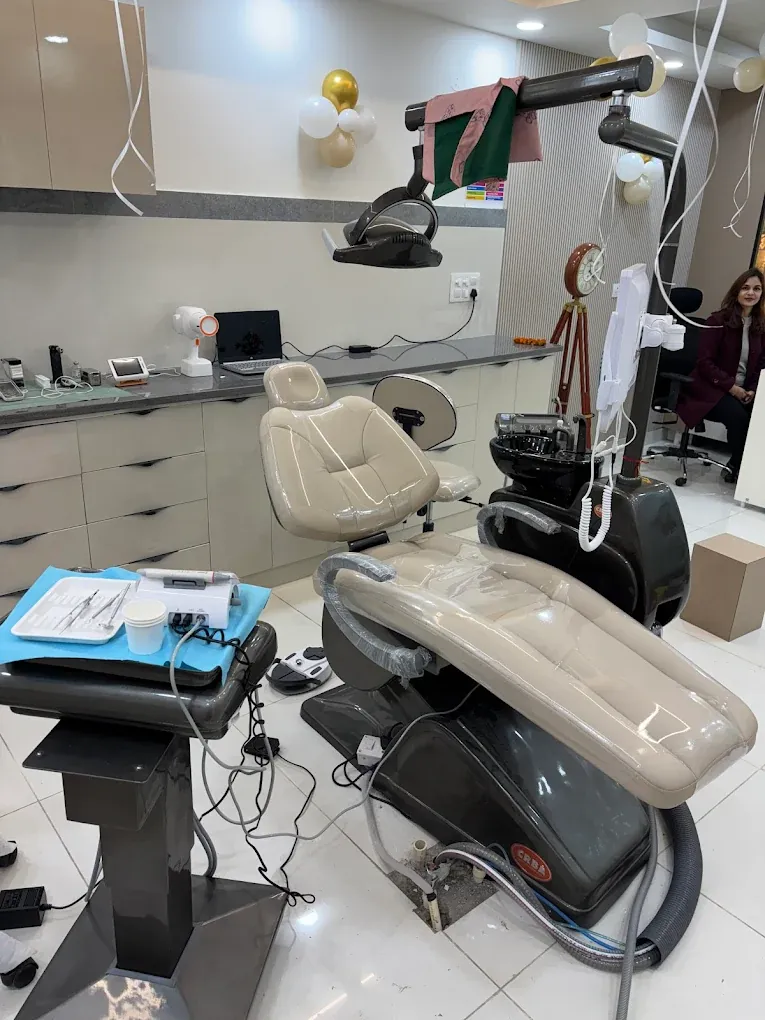
A significant proportion of adults avoid the dentist because they are frightened. It is rarely irrational — most people who are afraid had a genuinely bad experience, usually years ago, often as a child, and frequently involving being told to be brave while something hurt.
The cost of avoidance is the problem. A cavity that needed a filling becomes a root canal, then an extraction. The longer the gap, the more there is to face, and the more the fear is justified by the scale of the work. It is a loop, and breaking it early is far easier than breaking it late.
What actually helps
Say so at the start. Not in the chair, but when booking. It changes how the appointment is planned — more time, a slower pace, and no assumption that treatment happens that day.
Ask for a consultation only. A first visit can legitimately be nothing but talking and looking. No instruments, no drill, no decisions. For many nervous patients that single appointment does most of the work, because the anticipation is worse than the reality.
Agree a stop signal. Raising your left hand means stop, and it must be honoured immediately and without irritation. Knowing you can stop is what restores control, and lack of control is the core of most dental fear.
Ask for the numbing gel. A topical anaesthetic applied before the injection means you should not feel the needle. If the fear is specifically of injections, say that explicitly — the technique can be adjusted, warmed anaesthetic and slow delivery make a real difference.
Bring headphones. The sound of the drill is a trigger for a great many people, more than the sensation. Music or a podcast removes it.
Book a morning appointment. Less time to dread it, and you are less tired.
What we do differently for nervous patients
Tell-show-do rather than surprises: we explain what is about to happen, show you the instrument if you want to see it, then do it. We break long treatment into shorter visits where that helps. We do not lecture people about why they have not been for six years — that conversation achieves nothing except making the next gap longer.
Appointments run unhurried by design. Being rushed is what most anxious patients remember worst.
Where fear is severe
For genuine dental phobia, where the anxiety prevents attendance altogether, options include sedation, which leaves you conscious but deeply relaxed and with little memory of the procedure. It has to be discussed and planned in advance, with a proper medical history. Cognitive behavioural approaches also have good evidence for dental phobia specifically.
If it has been years
Come anyway. The examination is looking and an X-ray, nothing more. You will get a written plan, in order of priority, with costs, and you decide what happens and when. Nobody is going to be surprised by the state of your mouth — we see it every week, and it is a good deal more common than you think.
Frequently asked questions
What if I haven't been to a dentist in ten years?
It is more common than you think and nobody will comment on it. The first visit is an examination and an X-ray, followed by a written plan in priority order. You decide what is done and when.
Can I have a consultation without any treatment?
Yes, and for anxious patients we often recommend exactly that. A first appointment can be nothing but talking and looking, with treatment planned for a separate visit once you are ready.
Is sedation available for nervous patients?
For severe dental anxiety, sedation can be discussed and arranged in advance with a full medical history. For most patients, a slower pace, topical anaesthetic and an agreed stop signal are enough.
How do I stop being afraid of the injection?
Say that it is specifically the injection. A topical numbing gel beforehand, warmed anaesthetic and slow delivery make a substantial difference, and most patients find they do not feel the needle at all.
Talk to a dentist in Dehradun
Telling us you are anxious when you book changes how the whole appointment is planned. If you would like this looked at, it is what we do every day at Vital Dental Care & Implant Center, Haripuram Colony, 2 GMS Road, Engineers Enclave, Kanwali, Dehradun, Uttarakhand 248001 — close to Vasant Vihar, Kamla Palace, Chaman Vihar, Majra and Niranjanpur (how to reach us).
- Consulting hoursSunday to Friday, 10:00–14:00 and 16:00–20:00. Closed Saturday.
- Treating dentistDr. Pragati Singh, B.D.S., M.D.S. — Endodontist
- Appointments92868 98353 or WhatsApp
Related: What happens at a first visit, how often to get checked, painless root canal treatment.