
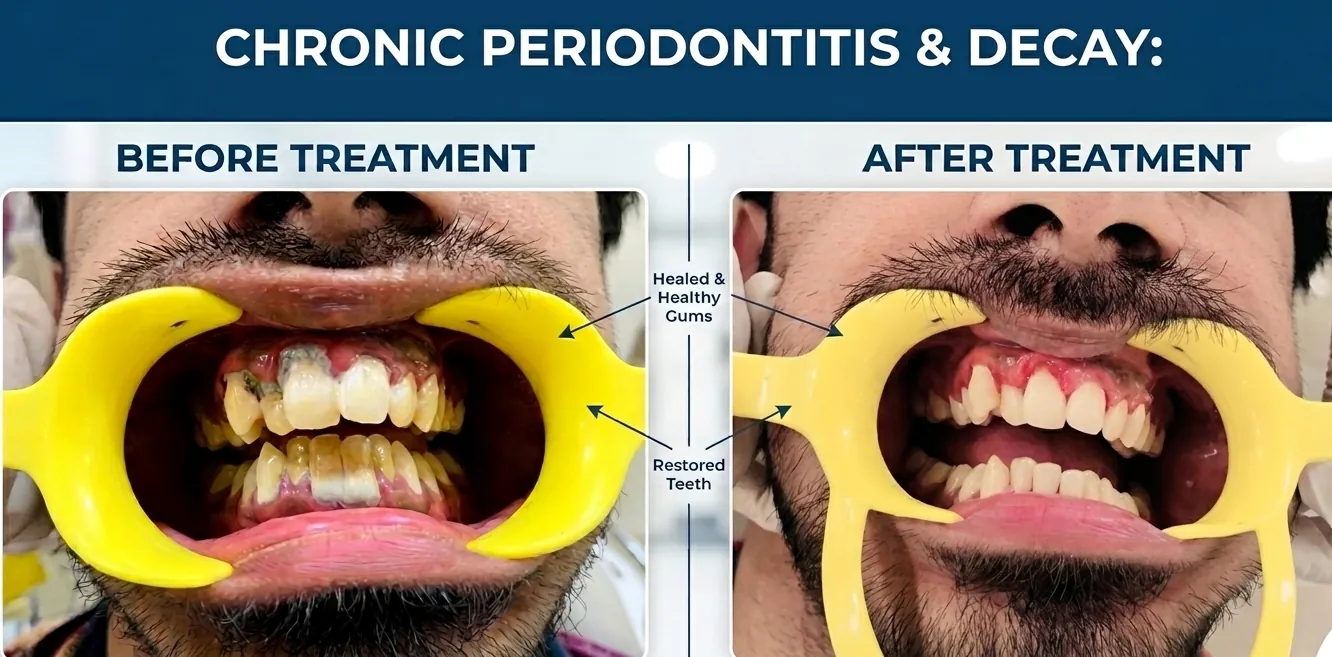
Almost everyone who comes to us with bleeding gums says the same sentence: “it’s only a little blood when I brush.” It is worth being blunt about this — healthy gums do not bleed. Not when you brush, not when you floss, not when you bite an apple. Bleeding is inflammation, and inflammation in the mouth almost always means bacterial plaque sitting where it should not be.
Why gums bleed
Within about 24 hours of not being cleaned properly, plaque begins to harden into calculus (tartar). Tartar is rough, porous and impossible to brush off. Your body recognises the bacteria living in it as a threat and sends blood flow to the area. That is why the gum turns from pale pink to red, swells slightly, and bleeds at the lightest touch.
The most common causes we see in Dehradun are:
- Plaque and tartar build-up — by far the commonest, and completely reversible early on.
- Brushing too hard, or with a hard brush — this damages gums rather than cleaning them.
- Skipping between the teeth — a toothbrush cannot reach roughly 40% of a tooth's surface.
- Smoking or tobacco chewing — which masks bleeding while making the disease worse underneath.
- Diabetes, pregnancy or certain medicines — all change how gums respond to plaque.
- Vitamin C or K deficiency — less common, but real.
Gingivitis or periodontitis?
This distinction matters more than any other in gum care. Gingivitis is inflammation of the gum only. Nothing has been lost yet, and a professional cleaning plus better technique at home reverses it completely within a couple of weeks.
Periodontitis is what gingivitis becomes if it is left. The inflammation reaches the bone holding the tooth in, and that bone starts to recede. Bone does not grow back on its own. This is why the phrase “it’s only a little blood” is expensive: the window in which the problem is fully reversible is measured in months, and it closes quietly.
Signs it has moved past gingivitis include gums pulling away from the teeth, teeth looking longer, persistent bad breath, a bad taste, teeth that feel slightly loose, or a change in how your teeth meet when you bite.
How it is treated
Treatment is staged according to how far things have gone:
- Scaling and polishing removes tartar above the gumline. For gingivitis this is usually all that is needed.
- Root planing (deep cleaning) cleans the root surfaces below the gumline, under local anaesthesia, where pockets have formed.
- Localised antibiotics or antiseptic irrigation where specific pockets are infected.
- Surgical gum treatment for advanced cases where pockets are too deep to clean without access.
Scaling does not loosen teeth or create gaps, which is the fear we hear most often. What it does is remove the tartar that was filling a gap the disease had already created. The tooth was never being held by tartar.
What actually stops it coming back
Cleaning between the teeth once a day does more for bleeding gums than any change to your brushing. Use a soft brush at a 45-degree angle to the gumline, replace it every three months, and have the tartar professionally removed roughly every six months. If you use tobacco in any form, stopping will change your gum health more than anything a dentist can do.
Give it two weeks of genuinely good cleaning. If the bleeding has not stopped by then, it has gone past what home care can fix and needs looking at.
Frequently asked questions
Should I stop brushing if my gums bleed?
No — this is the most common mistake. The bleeding is caused by the plaque you are not removing, so stopping makes it worse. Brush gently with a soft brush and the bleeding usually settles within one to two weeks.
Does scaling damage enamel or create gaps between teeth?
No. Ultrasonic scaling removes hardened tartar, not tooth structure. Any gaps you notice afterwards were already there, hidden under the tartar that was filling them.
How much does teeth cleaning cost in Dehradun?
A routine scaling and polishing is one of the least expensive treatments in dentistry, and far cheaper than treating the bone loss that follows if it is skipped. We confirm the cost at the consultation, before anything is started.
Can bleeding gums be a sign of something other than dental problems?
Yes. Diabetes, pregnancy, blood-thinning medication, vitamin deficiencies and some blood disorders all show up in the gums. If your cleaning is good and the bleeding persists, it is worth investigating further.
Talk to a dentist in Dehradun
Bleeding gums are easiest to fix in the first few months. If you would like this looked at, it is what we do every day at Vital Dental Care & Implant Center, Haripuram Colony, 2 GMS Road, Engineers Enclave, Kanwali, Dehradun, Uttarakhand 248001 — close to Vasant Vihar, Kamla Palace, Chaman Vihar, Majra and Niranjanpur (how to reach us).
- Consulting hoursSunday to Friday, 10:00–14:00 and 16:00–20:00. Closed Saturday.
- Treating dentistDr. Pragati Singh, B.D.S., M.D.S. — Endodontist
- Appointments92868 98353 or WhatsApp
Related: Teeth cleaning & gum care, diabetes and gum disease, bad breath.