
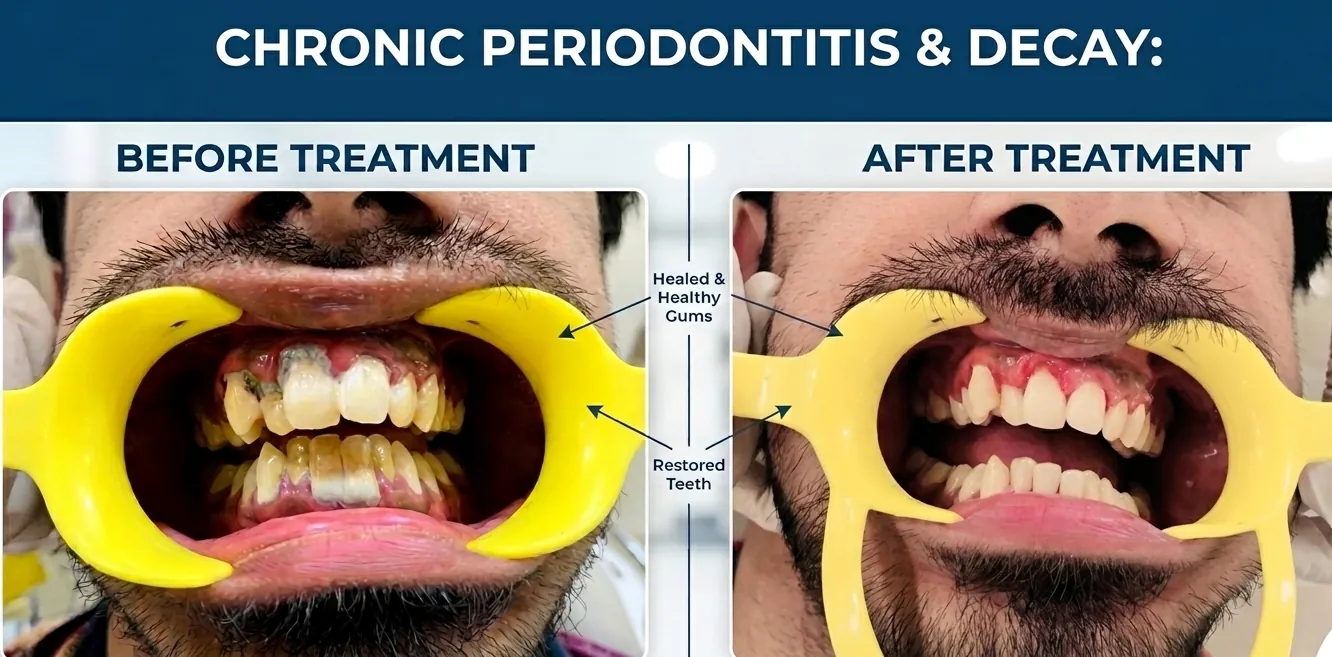
Gum disease is the leading cause of tooth loss in adults, and it is almost entirely painless until it is advanced. By the time teeth feel loose, a great deal of supporting bone has gone, and bone does not regrow on its own. Treatment is therefore about stopping the loss, not reversing it.
The stages of treatment
- Assessment. Pocket depths measured around every tooth, plus X-rays to show bone levels. Healthy is 1–3 mm. You should be shown your numbers.
- Scaling and polishing. For gingivitis — inflammation with no bone loss — this plus better cleaning at home reverses it completely. Nothing has been lost yet.
- Root planing (deep cleaning). Where pockets are 4 mm or deeper, root surfaces inside the pockets are cleaned under local anaesthetic, usually over two or more visits.
- Re-assessment, six to eight weeks later. Pockets are measured again. Many resolve at this point and need nothing further.
- Surgical treatment, for pockets that remain deep — folding the gum back to clean and reshape, sometimes with regenerative material where the defect shape allows.
- Maintenance, every three to four months for life. This is the part that decides whether the result holds.
Where lasers fit
Lasers are used as an adjunct to conventional treatment: to remove diseased tissue lining a pocket, reduce bacteria, and for gum reshaping, where they are genuinely elegant because they cut and seal simultaneously with less bleeding and faster comfort afterwards.
The honest position on evidence: laser treatment as an addition to scaling and root planing shows modest extra benefit in some studies, and it is generally more comfortable. What it does not do is replace mechanical cleaning of the root surface. Any clinic offering laser treatment instead of thorough root planing is selling the technology, not the treatment. Be sceptical of claims that a laser alone cures periodontitis.
What it costs
Cost follows the stage. Routine scaling is the least expensive appointment in dentistry. Root planing costs more, priced per quadrant or per session, because it takes far longer and needs anaesthetic. Surgery costs more again. Laser use is usually an addition to those fees.
Set against that: treating gum disease early costs a fraction of replacing the teeth it eventually takes. An implant to replace one tooth lost to periodontitis typically costs more than a decade of three-monthly maintenance visits.
The part only you can do
No treatment holds without daily cleaning between the teeth and, if you smoke, stopping. Smoking both drives gum disease and masks it, because it constricts blood vessels so the gums bleed less and look deceptively healthy while bone is lost underneath.
Frequently asked questions
Can laser treatment cure gum disease on its own?
No. Lasers are a useful addition to scaling and root planing, with modest extra benefit and more comfort, but the root surfaces still need mechanical cleaning. Be cautious of any clinic offering laser instead of that.
Does gum treatment hurt?
Root planing is done under local anaesthetic, so the procedure itself does not hurt. Gums can be tender and teeth sensitive for a few days afterwards.
Will my gums grow back after treatment?
Gum inflammation resolves and pockets shrink, but bone already lost does not regrow, except in specific defect shapes where regenerative techniques can help. Treatment stops further loss, which is why acting early matters.
How often will I need maintenance visits?
Every three to four months after active treatment, rather than six-monthly. Periodontitis is controlled, not cured, and the maintenance interval is what keeps it stable.
Talk to a dentist in Dehradun
Ask to see your pocket measurements before and after treatment. If you would like this looked at, it is what we do every day at Vital Dental Care & Implant Center, Haripuram Colony, 2 GMS Road, Engineers Enclave, Kanwali, Dehradun, Uttarakhand 248001 — close to Vasant Vihar, Kamla Palace, Chaman Vihar, Majra and Niranjanpur (how to reach us).
- Consulting hoursSunday to Friday, 10:00–14:00 and 16:00–20:00. Closed Saturday.
- Treating dentistDr. Pragati Singh, B.D.S., M.D.S. — Endodontist
- Appointments92868 98353 or WhatsApp
Related: Gum care and cleaning, bleeding gums, cleaning costs.